Summation and Product Notation
Before working with infinite series, power series, or Taylor expansions, it pays to be fluent in the two compact notations that all of them are written in: summation (sigma, ) and product (pi, ). Both are just shorthand for “repeat this operation over a range of indices” — sums for , products for .
Summation (Sigma) Notation
A sum is written as:
- is the index of summation.
- is the lower limit (where the index starts) and the upper limit.
- is the summand — the rule applied to each index.
When the sum is infinite, and whether it equals a finite value is exactly the question of convergence.
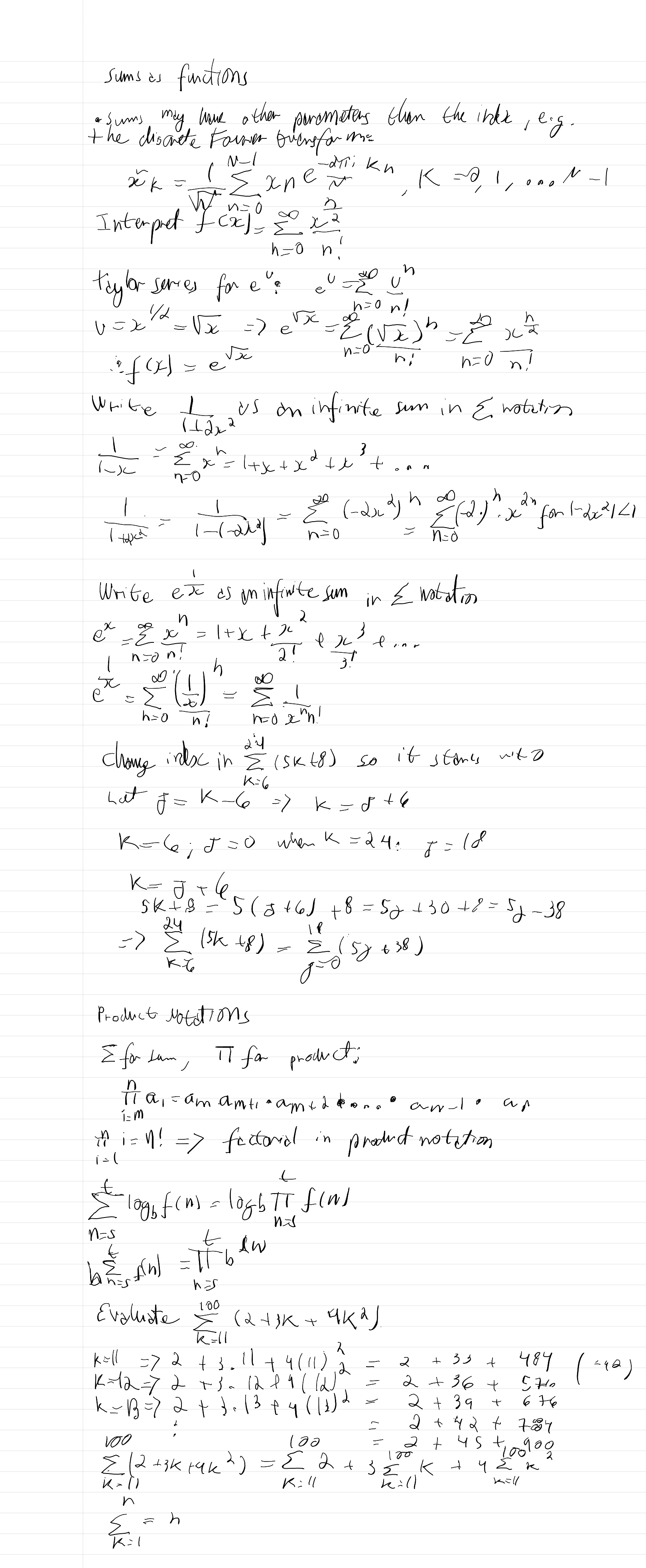
Reading a sum as a function
The key idea is that a sum whose summand depends on is itself a function of . The geometric series is the canonical example:
The left side is an ordinary function; the right side is the same function expressed as an infinite sum. Moving fluidly between the two forms is the whole game behind power series.
Useful manipulations
- Re-indexing (shifting): — shift the limits and compensate inside.
- Linearity: .
- Splitting: pull out the first term(s) to change where a series starts, e.g. .
Product (Pi) Notation
The multiplicative counterpart uses a capital pi:
Everything transfers over with in place of . The most important special case is the factorial, which is just a product of consecutive integers:
Factorials are why product notation matters for series at all — they appear in the denominators of Maclaurin and Taylor expansions.
Sum–product duality via logs
Logarithms turn products into sums, which is often how a product is evaluated:
Why this is the foundation
Every series note in this garden is written in this notation:
- Series Convergence — when an infinite has a finite value.
- Power Series — a whose summand is a power of .
- Taylor and Maclaurin Series — power series with factorial (a ) coefficients.
Foundational note — the anchor the rest of the series cluster links back to.