Vector Spaces, Subspaces and Span
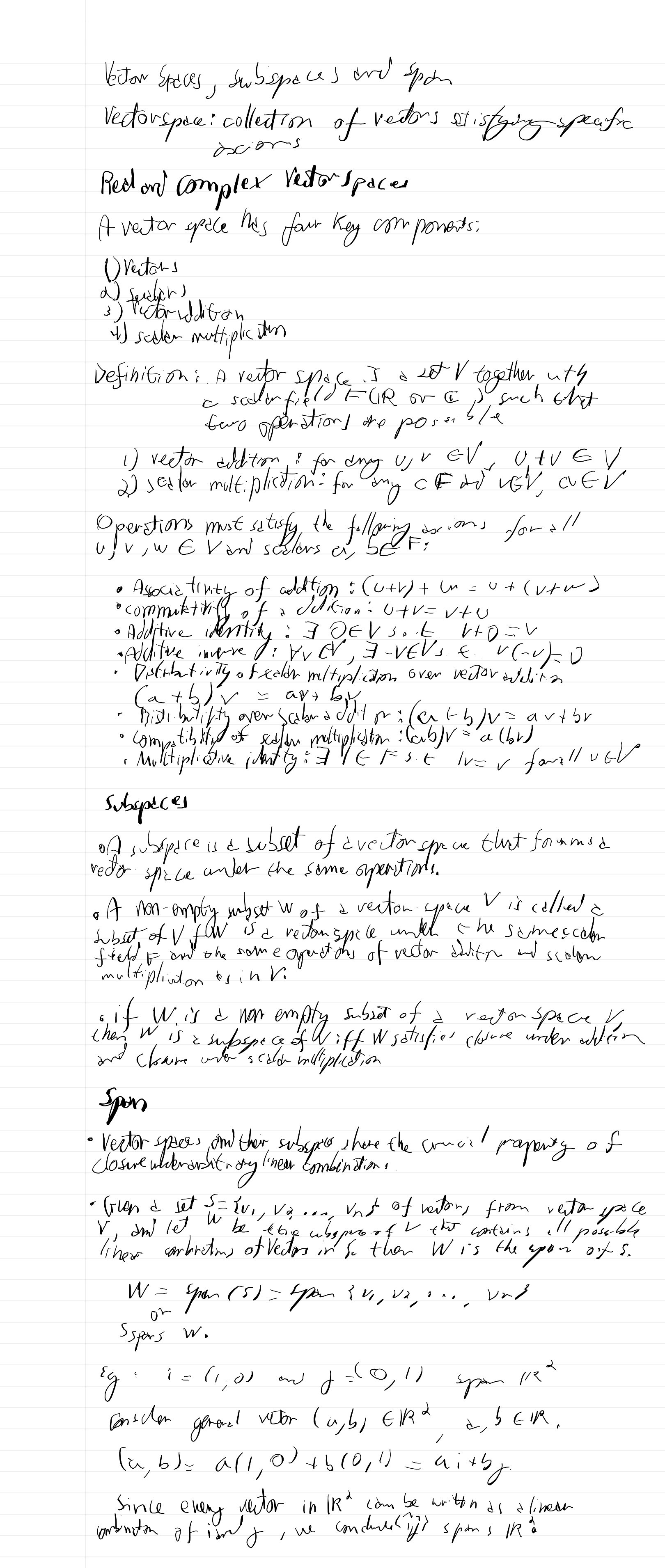
Vector space: collection of vectors satisfying specific axioms.
Real and Complex Vector Spaces
A vector space has four key components:
- Vectors
- scalars
- Vector addition
- scalar multiplication
Definition: A vector space is a set together with a scalar field ( or ), such that two operations are possible:
- vector addition: for any ,
- scalar multiplication: for any and ,
Operations must satisfy the following axioms for all and scalars :
- Associativity of addition:
- commutativity of addition:
- Additive identity: s.t.
- Additive inverse: , s.t.
- Distributivity of scalar multiplication over vector addition:
- Distributivity over scalar addition:
- Compatibility of scalar multiplication:
- Multiplicative identity: s.t. for all
Subspaces
- A subspace is a subset of a vector space that forms a vector space under the same operations.
- A non-empty subset of a vector space is called a subset of if is a vector space under the same scalar field and the same operations of vector addition and scalar multiplication as in .
- If is a non-empty subset of a vector space , then is a subspace of iff satisfies closure under addition and closure under scalar multiplication.
Span
- Vector spaces and their subspaces share the crucial property of closure under arbitrary linear combination.
- Given a set of vectors from vector space , and let be the subspace of that contains all possible linear combinations of vectors in , then is the span of .
or spans .
Eg: and span .
Consider general vector , .
Since every vector in can be written as a linear combination of and , we conclude spans .