Complex Numbers Operations
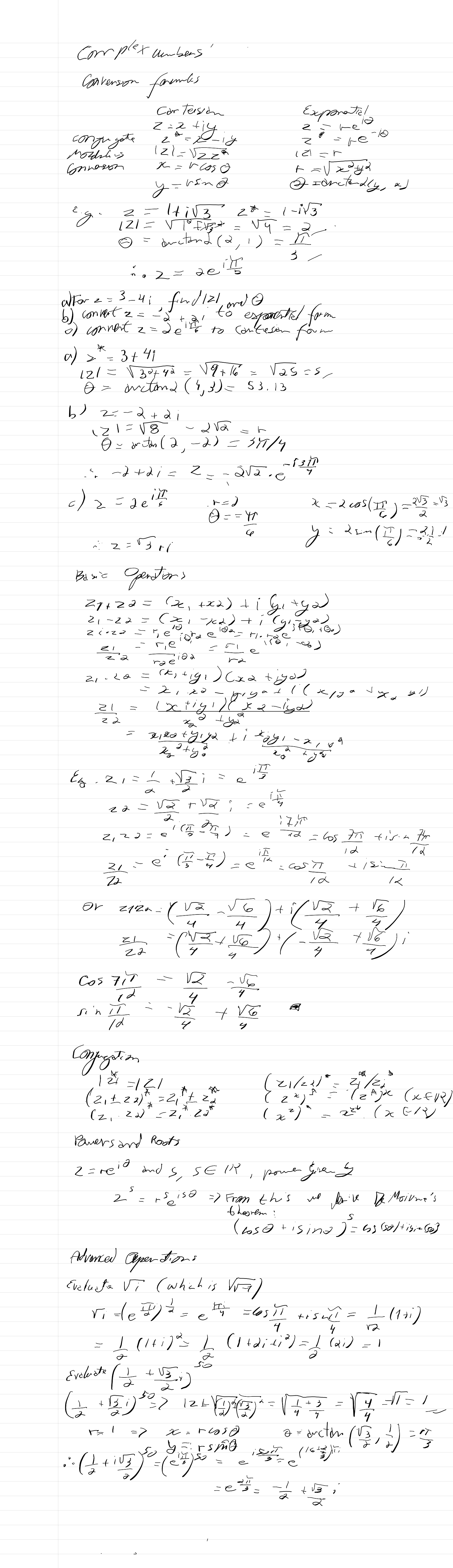
| Cartesian | Exponential |
|---|
| z=x+iy | z=reiθ |
| conjugate | z∗=x−iy | z∗=re−iθ |
| modulus | ∥z∥=zz∗ | ∥z∥=r |
| conversion | x=rcosθ, y=rsinθ | r=x2+y2, θ=arctan2(y,x) |
E.g.
z=1+i3z∗=1−i3
∣z∣=12+32=4=2
θ=arctan2(2,1)=3π
∴z=2ei3π
a) For z=3−4i, find ∣z∣ and θ
b) Convert z=−2+2i to exponential form
c) Convert z=2ei6π to cartesian form
a)
z∗=3+4i
∣z∣=32+42=9+16=25=5
θ=arctan2(4,3)=53.13
b)
z=−2+2i
∣z∣=8=22=r
θ=arctan(2,−2)=3π/4
∴−2+2i=z=22⋅ei43π
c)
z=2ei6πr=2,θ=6π
x=2cos(6π)=223=3
y=2sin(6π)=22⋅1=1
∴z=3+i
Basic Operations
z1+z2=(x1+x2)+i(y1+y2)
z1−z2=(x1−x2)+i(y1−y2)
z1⋅z2=r1eiθ1⋅r2eiθ2=r1⋅r2ei(θ1+θ2)
z2z1=r2eiθ2r1eiθ1=r2r1ei(θ1−θ2)
z1⋅z2=(x1+iy1)(x2+iy2)=x1x2−y1y2+i(x1y2+x2y1)
z2z1=x22+y22(x1+iy1)(x2−iy2)=x22+y22x1x2+y1y2+ix22+y22x2y1−x1y2
E.g.
z1=21+23i=ei3π
z2=22+22i=ei4π
z1z2=ei(3π+4π)=ei127π=cos127π+isin127π
z2z1=ei(3π−4π)=ei12π=cos12π+isin12π
Or
z1z2=(42−46)+i(42+46)
z2z1=(42+46)+(−42+46)i
cos127π=42−46
sin12π=−42+46
Conjugation
∣z∗∣=∣z∣
(z1±z2)∗=z1∗±z2∗
(z1⋅z2)∗=z1∗⋅z2∗
(z1/z2)∗=z1∗/z2∗
(zx)∗=(z∗)x(x∈R)
(xz)∗=xz∗(x∈R)
Powers and Roots
z=reiθ and s, s∈R, power given by
zs=rseisθ
⇒ From this we derive De Moivre’s theorem:
(cosθ+isinθ)s=cos(sθ)+isin(sθ)
Advanced Operations
Evaluate i (which is −1)
i=(e2πi)21=e4πi=cos4π+isin4π=21(1+i)
=21(1+i)2=21(1+2i+i2)=21(2i)=i
Evaluate (21+23i)50
(21+23i)50⇒∣z∣=(21)2+(23)2=41+43=44=1=1
r=1⇒x=rcosθ,y=rsinθθ=arctan(23,21)=3π
∴(21+i23)50=(ei3π)50=ei350π=e(16+32)πi
=ei32π=−21+23i