Special Angles and Function Values
Some angles are special because their trig values come out as finite radical expressions — clean numbers like , and rather than endless decimals. These are the angles worth committing to memory, and laying them around the unit circle is the standard way to do it. This builds directly on trigonometric-functions-properties-and-inverses, where the functions are defined as coordinates on that circle.
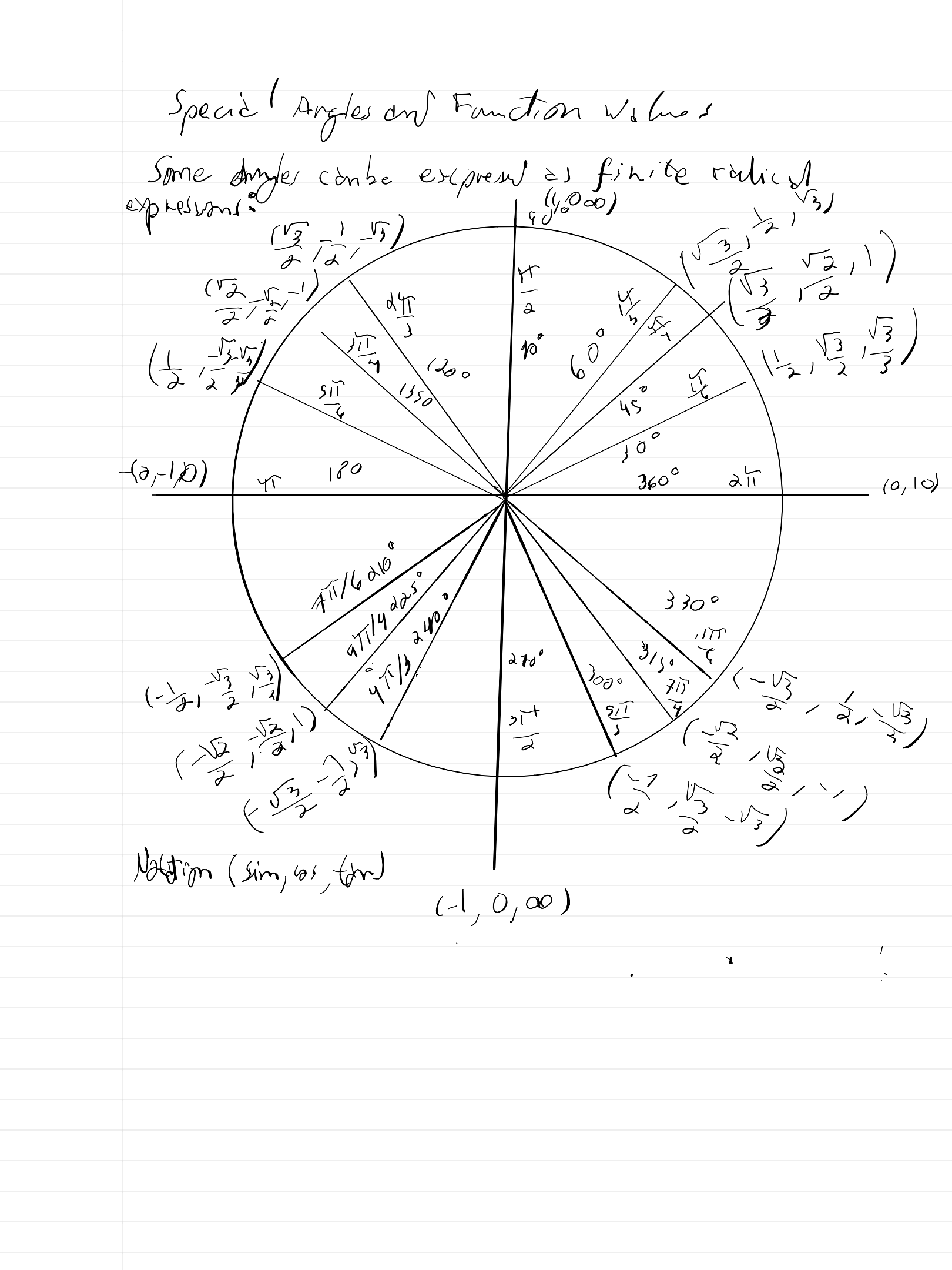
The unit circle
Each point on the unit circle is , and is the slope of the radius. The special angles are the multiples of () and (), which split each quadrant evenly.
The four quadrantal angles sit on the axes:
| Angle | Radians | ||
|---|---|---|---|
First-quadrant values
Memorise the first quadrant and the rest follow by symmetry. A handy pattern: writing each sine as for makes the progression obvious.
| Angle | Radians | |||
|---|---|---|---|---|
Reading down and up, the two columns are mirror images — a direct consequence of the co-function relationship .
Extending by symmetry
The other three quadrants are reflections of the first, so only the signs change — the magnitudes stay identical to the matching reference angle:
| Quadrant | Angle range | |||
|---|---|---|---|---|
| I | – | |||
| II | – | |||
| III | – | |||
| IV | – |
So, for instance, has reference angle in quadrant II, giving ; and has reference angle in quadrant III, giving . The sign rule is just the even/odd and quadrant symmetry discussed in trigonometric-functions-properties-and-inverses.
Draft note: a future reference-angles note could expand the symmetry trick into a general method for any angle.