Trigonometric Functions, Properties and Inverses
The starting point of trigonometry. Angles are often written in degrees, but the convention for trig is to work in radians, where
Everything below — definitions, periods, symmetry, inverses — follows once you see the trig functions as ratios read off a triangle and, more generally, off the unit circle. The companion note special-angles-and-function-values tabulates the exact values these functions take at the common angles.
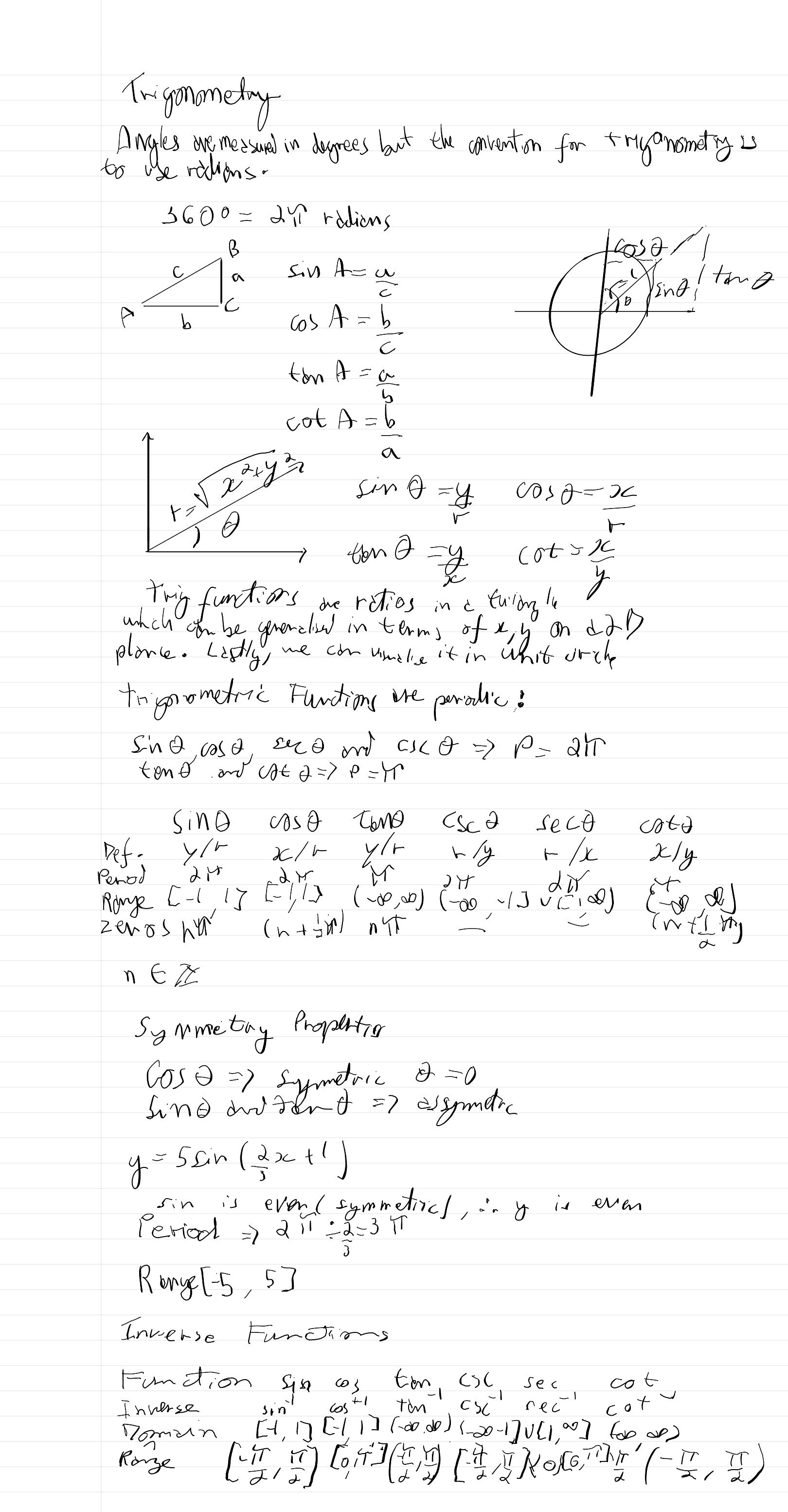
Functions as ratios
For a right triangle with the angle opposite side , adjacent side , and hypotenuse :
To extend these beyond acute angles, place the angle at the origin and read the ratios off a point on a circle of radius :
On the unit circle () this collapses to the familiar picture: is the horizontal coordinate, the vertical coordinate, and the slope of the radius. The remaining two functions are reciprocals: and .
Periodicity, domain and range
Because the functions are defined by going around the circle, they are periodic. The sine/cosine pair (and their reciprocals) repeat every full turn; tangent and cotangent repeat every half turn:
With :
| Function | Domain | Period | Range |
|---|---|---|---|
| all | |||
| all | |||
The gaps in the domains are exactly the angles where a denominator vanishes: kills and , while kills and .
Symmetry properties
Reflecting the angle across the -axis (sending ) reveals each function’s parity:
- Cosine is even — — because the horizontal coordinate is unchanged by the reflection. Its graph is symmetric about the -axis.
- Sine and tangent are odd — and — they flip sign, giving graphs symmetric about the origin (antisymmetric).
Phase shifts trade one function for another. For example can be unwound with the angle-addition identity, and it turns out to equal — an even function. So a sine with the right shift inherits cosine’s symmetry.
Inverse functions
Each trig function is many-to-one, so to invert it we restrict the domain to a single monotone branch. The result is an inverse whose range is that chosen branch:
| Inverse | Domain | Range |
|---|---|---|
Notice the domains of the inverses are just the ranges of the originals, as expected when you swap input and output. The restricted output intervals are the price of making each function one-to-one.
Draft note: connect this to special-angles-and-function-values for the exact values, and a future note on the angle-addition-identities used in the symmetry example.