Set Theory Principles, Definitions and Identities
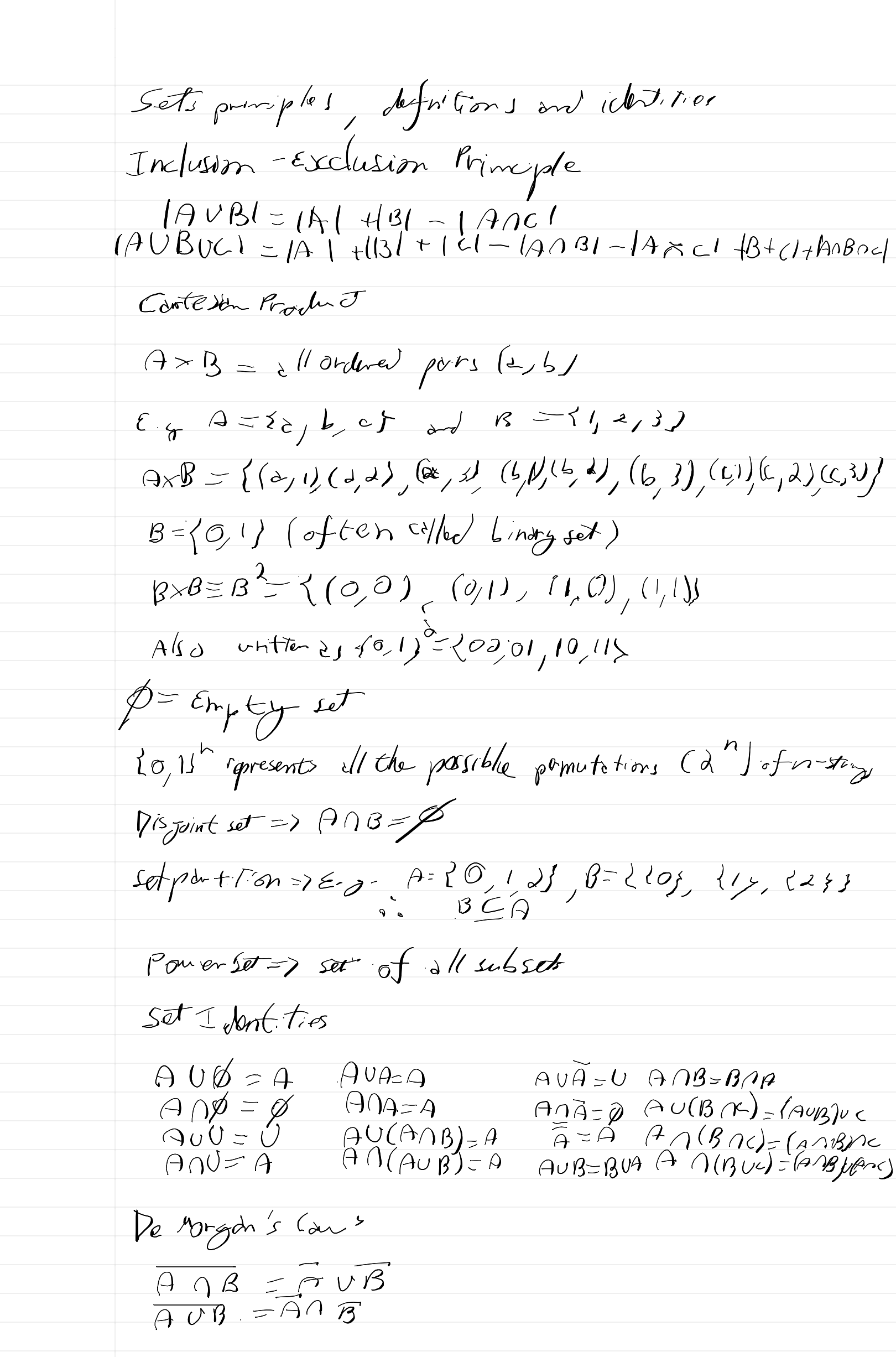
Inclusion-Exclusion Principle
∣A∪B∣=∣A∣+∣B∣−∣A∩B∣
∣A∪B∪C∣=∣A∣+∣B∣+∣C∣−∣A∩B∣−∣A∩C∣−∣B∩C∣+∣A∩B∩C∣
Cartesian Product
A×B = all ordered pairs (a,b)
E.g. A={a,b,c} and B={1,2,3}
A×B={(a,1),(a,2),(a,3),(b,1),(b,2),(b,3),(c,1),(c,2),(c,3)}
B={0,1} (often called binary set)
B×B≡B2={(0,0),(0,1),(1,0),(1,1)}
Also written as {0,1}2={00,01,10,11}
Definitions
∅ = Empty set
{0,1}n represents all the possible permutations (2n) of n-strings
Disjoint set ⇒A∩B=∅
Set partition ⇒ E.g. A={0,1,2}, B={{0},{1},{2}} ∴B⊆A
Power set ⇒ set of all subsets
Set Identities
| | | |
|---|
| A∪∅=A | A∪A=A | A∪Aˉ=U | A∩B=B∩A |
| A∩∅=∅ | A∩A=A | A∩Aˉ=∅ | A∪(B∪C)=(A∪B)∪C |
| A∪U=U | A∪(A∩B)=A | Aˉˉ=A | A∩(B∩C)=(A∩B)∩C |
| A∩U=A | A∩(A∪B)=A | A∪B=B∪A | A∩(B∪C)=(A∩B)∪(A∩C) |
De Morgan’s Laws
A∩B=Aˉ∪Bˉ
A∪B=Aˉ∩Bˉ